

The Digital Bridge: Demystifying Stablecoins
Stablecoins are cryptocurrencies designed for price stability, usually pegged to fiat currencies like the US dollar, serving as a crucial bridge between volatile digital assets and traditional finance. They come in various forms—fiat-backed, crypto-backed, algorithmic, and commodity-backed—each with unique mechanisms to maintain their peg and inherent risks.
Key Takeaways
- Stablecoins provide price stability: They aim to maintain a fixed value relative to a reference asset (e.g., USD), solving the volatility problem of traditional cryptocurrencies like Bitcoin.
- Diverse types with distinct backing: Stablecoins are categorized into fiat-collateralized, crypto-collateralized, algorithmic, and commodity-backed, each with different collateralization methods and levels of centralization/decentralization.
- Stability mechanisms are key: Each type uses specific "pegging" mechanisms (e.g., redemption, over-collateralization & liquidation, or algorithmic mint-and-burn) to maintain its value, which also determine its risk profile.
- Inherent risks exist: Stablecoins face risks such as counterparty risk (for fiat-backed), smart contract risk (for crypto-backed and algorithmic), and the potential for de-pegging, as evidenced by historical events.
- Not CBDCs: While both offer stable digital value, stablecoins are privately issued, whereas Central Bank Digital Currencies (CBDCs) are government-issued and backed, representing fundamentally different trust and governance models.
Introduction: Money in the Digital Age
In the rapidly evolving realm of digital finance, cryptocurrencies have emerged as a beacon of innovation. Yet, their unpredictable price swings pose significant challenges. Enter stablecoins, which aim to combine the innovative flexibility of digital assets with the dependable price stability of traditional currency. This solution is crucial for a range of stakeholders: everyday users seeking reliable transactions, financial professionals managing portfolios, regulators ensuring systemic stability, and developers building the next generation of financial applications. This article will explore the fundamentals of stablecoins, examining their definition, types, and the mechanisms they use to maintain value.
What Is a Stablecoin? A Plain-Language Definition
A stablecoin is a type of cryptocurrency specifically designed to maintain a stable value relative to a reference asset, usually the US dollar. Unlike volatile cryptocurrencies such as Bitcoin and Ethereum, whose values can fluctuate widely, stablecoins are engineered to offer consistency, making them more practical for everyday financial activities. The core concept behind stablecoins is the 'peg'—a target price that the stablecoin aims to track. Imagine a tether that keeps a balloon from drifting too far away. Similarly, the peg keeps the stablecoin's value close to its reference asset. Key use cases include facilitating cross-border transactions, preserving value during market turbulence, powering decentralized finance (DeFi) applications, and enabling programmable payments.
Why Stablecoins Matter: The Problem They Solve
Cryptocurrencies face a fundamental volatility problem: a digital currency that can change 20% in value overnight is impractical for payments, savings, or contracts. Stablecoins serve as a 'bridge' between the traditional financial world and the blockchain ecosystem, allowing users to transact in digital environments without the instability associated with most cryptocurrencies. With stablecoins facilitating trillions of dollars in transactions directly on blockchain networks annually, their real-world relevance is undeniable. Financial professionals utilize stablecoins for swift settlements, regulators monitor them for potential systemic risks, and developers leverage them to build innovative applications.
The Four Main Types of Stablecoins
-
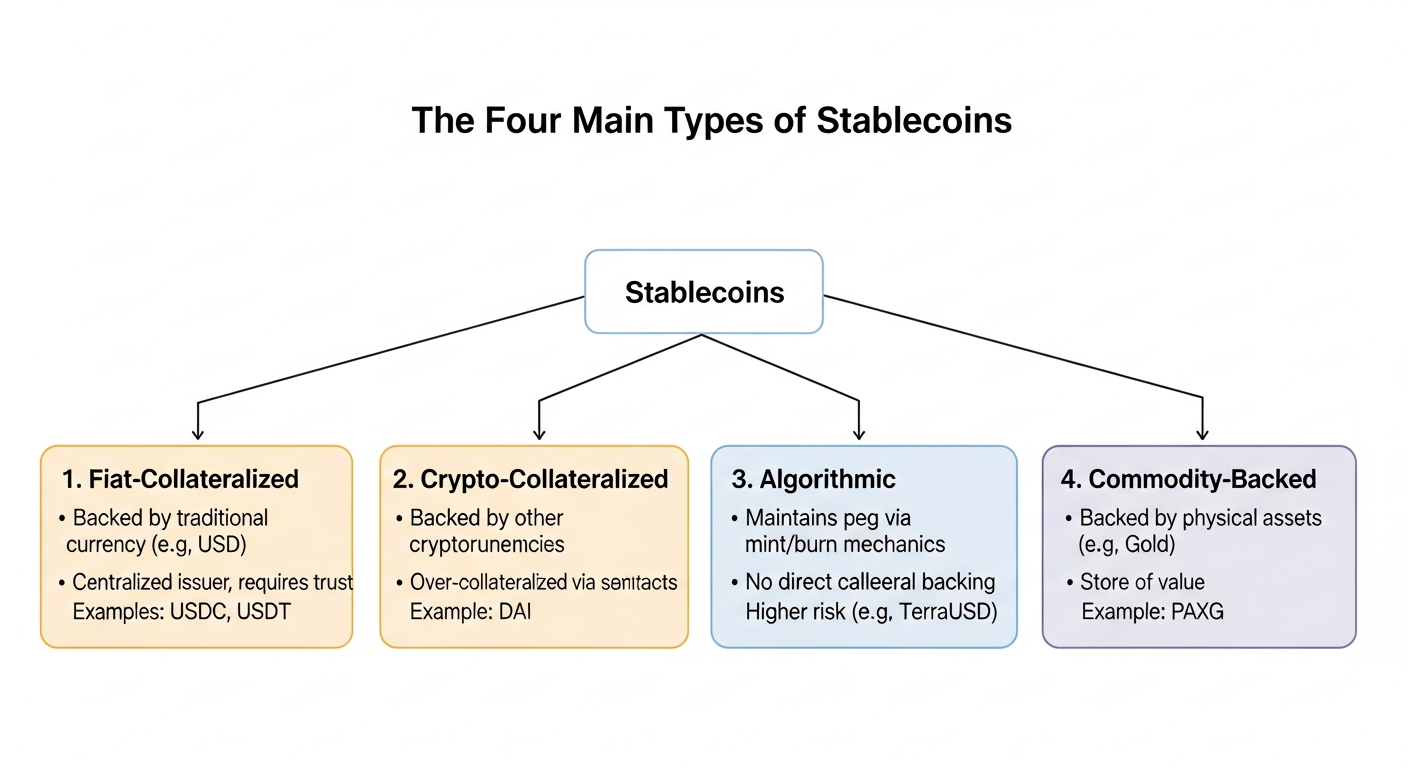
Fiat-Collateralized Stablecoins: These stablecoins are backed 1:1 by reserves of traditional currency, most commonly the US dollar, held by a central issuer in traditional bank accounts. Examples include USD Coin (USDC) and Tether (USDT). They are straightforward to understand but require trust in the issuer to hold the reserves and transparency in their regular audits.
-
Crypto-Collateralized Stablecoins: These are backed by other cryptocurrencies, locked in smart contracts on a blockchain. To absorb price swings in the underlying volatile assets, they are often over-collateralized (meaning more than $1 worth of crypto is held for every $1 stablecoin issued). An example is MakerDAO's DAI. These stablecoins are generally more decentralized but involve complex risk management through smart contract logic.
-
Algorithmic Stablecoins: These use software-driven supply and demand mechanisms—minting or burning tokens—to maintain their peg without direct collateral backing. While innovative in their approach, they are inherently higher risk, as tragically demonstrated by the TerraUSD (UST) collapse in 2022.
-
Commodity-Backed Stablecoins: These stablecoins are pegged to the value of physical assets like gold, silver, or oil, offering a digital value store tied to real-world commodities. An example is Paxos Gold (PAXG), which represents ownership of physical gold. While less common, they are gaining interest for their potential as an an inflation hedge or alternative store of value.
How Stablecoins Maintain Their Peg: A High-Level View
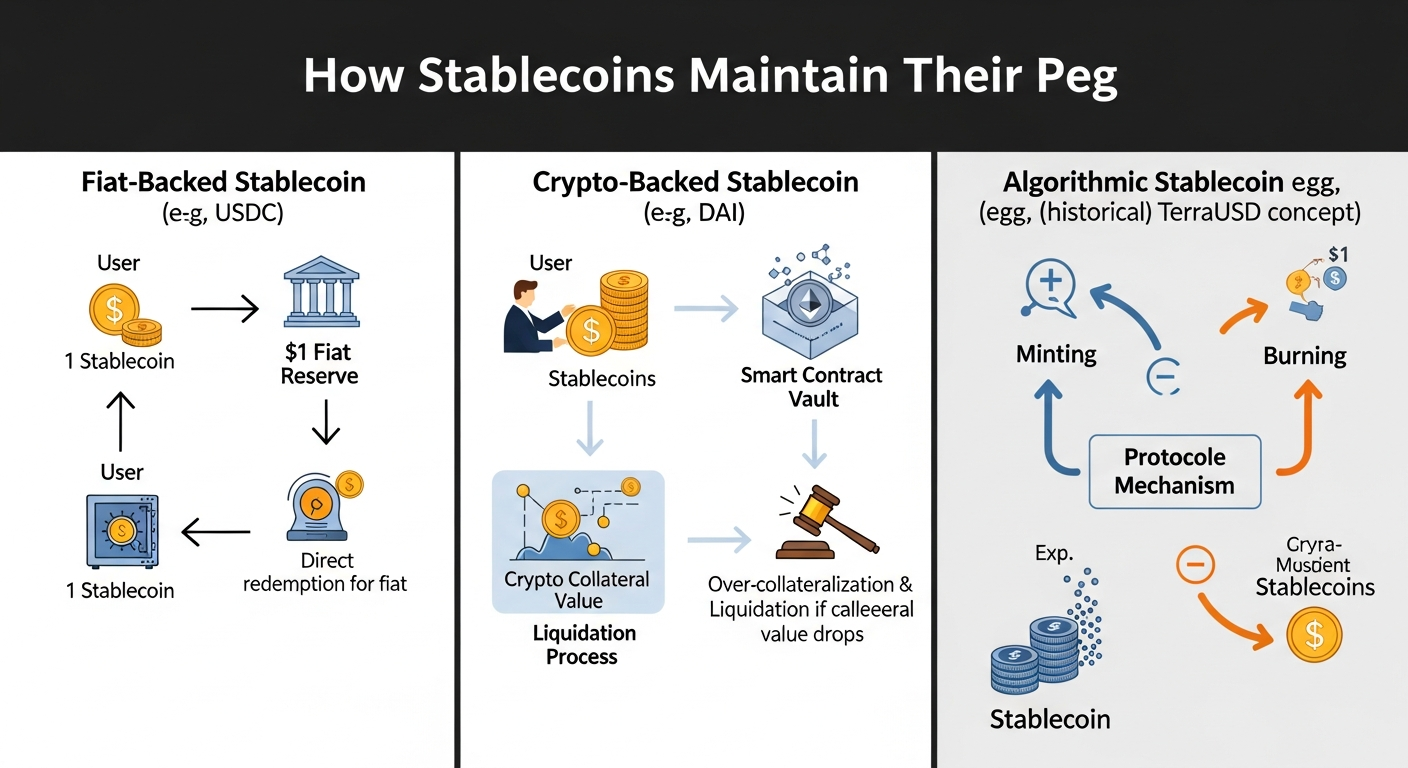
Every stablecoin relies on a specific stability mechanism, akin to an engine, to maintain its peg:
-
Fiat-Backed Coins: These utilize a direct redemption mechanism. Users can typically exchange 1 stablecoin for $1 of the underlying reserve currency (e.g., fiat USD). This creates powerful arbitrage incentives: if the stablecoin's market price deviates from $1, traders can profit by buying undervalued stablecoins and redeeming them for $1, or by minting new stablecoins and selling them if the price is above $1. This activity helps pull the stablecoin's price back to its target.
-
Crypto-Backed Coins: These employ over-collateralization and automated liquidation processes. Users deposit more value in volatile cryptocurrency (e.g., $1.50 worth of Ether) than the stablecoins they receive (e.g., $1 worth of DAI). If the value of the collateral drops too far (e.g., below $1.20 for a $1 stablecoin), the smart contract automatically sells, or liquidates, a portion of the collateral to protect the stablecoin's peg.
-
Algorithmic Coins: These rely on complex mint-and-burn dynamics. When the stablecoin's price is too high, the protocol algorithmically increases its supply (mints new tokens) to drive the price down. Conversely, when the price is too low, the protocol contracts the supply (burns tokens) to drive the price up. This mechanism, while aiming for decentralization, carries significant risk if market conditions overwhelm the algorithm's ability to restore the peg.
These mechanisms blend trust, collateral, sophisticated code, and economic incentives. Understanding which elements a stablecoin uses is essential for assessing its risk and reliability.
Key Risks and Limitations to Understand
-
Counterparty Risk: Fiat-backed and commodity-backed stablecoins depend on issuers actually holding the promised reserves. Mismanagement, fraud, or opacity in reserve audits can lead to a loss of trust and a de-peg.
-
Smart Contract Risk: Crypto-backed and algorithmic stablecoins rely heavily on the underlying code of smart contracts. These can contain vulnerabilities (bugs) or behave unexpectedly in extreme, unforeseen market conditions, leading to failures.
-
De-Pegging Events: Historical examples like TerraUSD's catastrophic collapse in 2022 and USDC's temporary de-peg in 2023 during the Silicon Valley Bank (SVB) crisis vividly illustrate that these risks are real, not just theoretical. A de-peg means the stablecoin loses its intended 1:1 value with its reference asset.
-
Regulatory Uncertainty: Stablecoins operate in a rapidly shifting legal landscape. There are ongoing global debates about their classification as securities, payment instruments, bank deposits, or other financial products, which impacts their operation and investor protection.
The Regulatory and Policy Landscape at a Glance
Given their increasing scale and potential systemic implications, stablecoins have become a priority for financial regulators worldwide. Key regulatory frameworks currently in development include the European Union's Markets in Crypto-Assets (MiCA) regulation, proposed US stablecoin legislation, and guidance from global bodies like the Financial Stability Board (FSB). The main regulatory concerns revolve around reserve transparency, robust consumer protection, anti-money laundering (AML) compliance, and mitigating potential risks to broader financial stability. This is an evolving space, and the stablecoin landscape will likely change significantly as regulations mature.
Stablecoins vs. CBDCs: A Quick Distinction
A common confusion arises between stablecoins and central bank digital currencies (CBDCs). Stablecoins are issued by private entities (companies or decentralized protocols) and backed by reserves they manage. In contrast, CBDCs are issued, backed, and governed by sovereign governments or their central banks. Both aim to provide stable digital value but differ fundamentally in governance, trust models (private vs. public), and design philosophy. Understanding stablecoins is foundational for grasping CBDCs.
Conclusion: A Foundation for Deeper Exploration
In summary, stablecoins are price-stable digital assets designed to bridge the gap between volatile cryptocurrencies and traditional finance. They come in four main types, each using distinct mechanisms to maintain their peg. This foundational knowledge is crucial whether you're assessing financial risk, writing policy, building innovative applications, or simply seeking to understand modern digital finance. We invite you to continue learning by exploring individual stablecoin types in depth, diving into decentralized finance (DeFi) use cases, or examining the regulatory frameworks taking shape globally.
Comments
Sign in to join the discussion
Sign In to Comment